Frequently Asked Questions
Answers about BattGenie, our physics-based battery software and how integration works. If your question is not here, get in touch.

About BattGenie
What does BattGenie do?
BattGenie builds physics-based battery software. Our electrochemical models describe what is happening inside each cell, and we run them where they are useful: on a battery management system’s microcontroller, in the battery lab, and in the cloud across fleets and energy-storage sites. The result is more accurate state of charge and health, faster charging and longer battery life, without new hardware.
What does "physics-based" mean?
Most battery management systems estimate state of charge from voltage lookup tables, equivalent circuit models or purely data-driven machine learning. A physics-based model instead describes the cell’s electrochemical and thermal behavior with a porous-electrode (P2D/DFN) model, using parameters measured on the real cell rather than taken from a datasheet. BattGenie reformulates these models so they solve in real time on standard BMS microcontrollers.
Which industries do you work with?
Electric vehicles, including heavy-duty commercial vehicles; grid and commercial battery energy storage (BESS); and consumer electronics. We work with battery labs, cell makers, OEMs, Tier 1 suppliers and fleet and storage operators. See Solutions.
Has the battery-life improvement been validated?
Yes. Physics-based optimal charging has more than doubled battery cycle life, an improvement in excess of 100 %, validated at cell, module and pack level, including independent testing at the US National Renewable Energy Laboratory (NREL). The same models let batteries charge in under 15 minutes without giving up cycle life. See Technology.
Is BattGenie’s technology patented?
Yes. Four granted US patents, each co-invented by co-founder Prof. Venkat Subramanian, cover the methods behind our software, and BattGenie holds an exclusive worldwide license to all four:
- US 10,037,395 B2: systems and methods for improving battery performance
- US 10,769,236 B2: a robust, fail-safe, iteration-free approach for solving the battery model’s equations
- US 11,462,929 B2: direct estimation of battery parameters from charge and discharge curves
- US 11,710,859 B2: controlling charging and discharging with a tanks-in-series model
Where is BattGenie based?
BattGenie grew out of Prof. Venkat Subramanian’s battery research lab at the University of Washington. We are headquartered at 2630 NW 62nd St, Seattle, WA 98107, and have lab space in Austin, Texas. Both labs run high-current, high-voltage cell and module cyclers.
Products
What products does BattGenie offer?
- BattGenie BMS: physics-based state estimation (BG_SOX) for battery management systems. BMS boards are now sampling.
- BattStudio: our battery R&D suite, made up of two services:
- BattOps: fleet and BESS analytics built on physics-based digital twins.
What is an FMU, and why does BattMaaS use them?
A Functional Mock-up Unit (FMU) is a packaged simulation model that follows the open FMI standard, so it can be dropped into a system-simulation tool without rewriting it. BattMaaS delivers BattGenie’s physics-based battery models as FMUs that work with 150+ simulation tools, or as compiled C, C++ or Python libraries. Our three-part FMU series explains how they work.
Are BattGenie BMS boards available?
Yes. BattGenie BMS boards, with electrochemical models running onboard, are now sampling. Request a sample or read more on the BMS Solution page.
BG_SOX state estimation
What is BG_SOX?
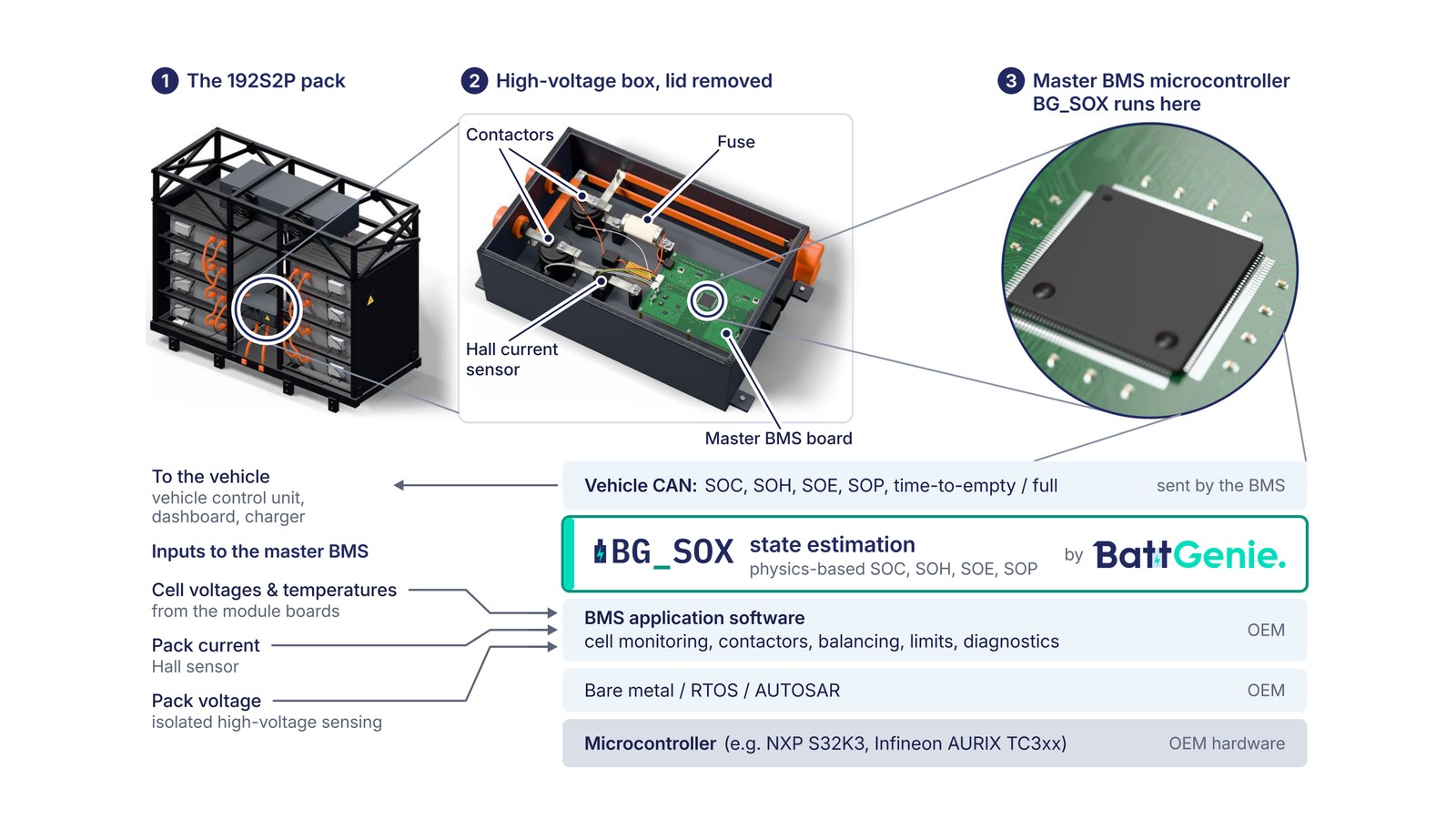
BG_SOX is BattGenie’s physics-based state estimator. It runs as software on the master BMS microcontroller and reports state of charge, state of health, state of energy, state of power (as charge and discharge limits), predicted cell voltage, and time to empty and to full. It uses only the measurements the BMS already takes.
How accurate is BG_SOX?
Integrated on the master BMS of a 192S2P LFP pack for a heavy-duty commercial vehicle and validated over 47 hours of dynamic, constant-current and intermittent cycling:
It carried its state through 11 BMS restarts and always erred on the safe side at empty. Read the short article, or the BG_SOX integration white paper for the method and the results in full, including where the estimate was weakest.
Why is state of charge hard to estimate on LFP batteries?
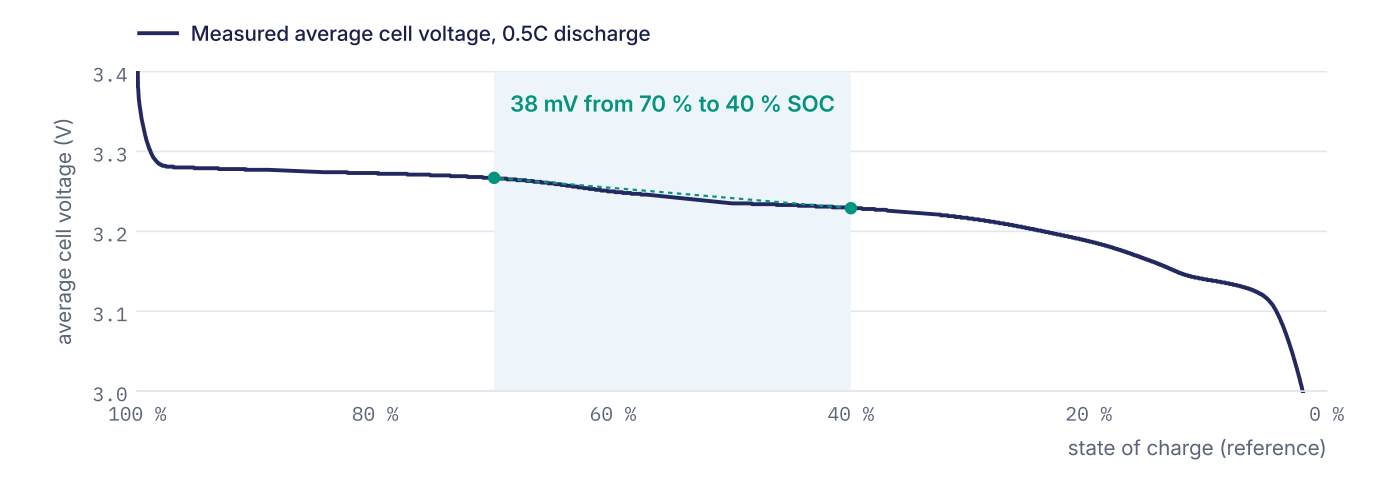
LFP cell voltage barely changes through the middle of the range: about 0.1 V from 20 to 80 % state of charge, and on our test pack just 38 mV from 70 to 40 %. LFP also shows hysteresis, and through the flat middle the estimate leans on the current sensor, so every sensor error accumulates. The usual answer is a bigger reserve: on a 282.6 kWh pack, each point of state of charge held back is about 2.8 kWh.
Where can I read the white papers and brochures?
Our technical papers and product brochures:
- BMS and BG_SOX: BG_SOX on an LFP truck pack (white paper, 2026), How to choose the right battery management system (white paper, 2022), and When the Current Sensor Lies (white paper, 2026, available on request).
- BattStudio: the BattStudio brochure, the BattDaaS white paper (PDF) and the BattMaaS white paper (PDF).
What happens if the current sensor drifts?
BG_SOX checks the coulomb count against the cell voltages and corrects state of charge when they disagree. In a 9.2-hour test on a 460 Ah LFP pack whose BMS read charge current up to 13 % high and discharge current up to 18 % low, coulomb counting alone ended 12.7 % off and an equivalent circuit model with a Kalman filter averaged 1.7 % RMS error. BattGenie’s estimator averaged 0.5 % and was never more than 2.0 % off. These figures come from BattGenie internal testing; the full white paper is available on request.
Integration
Do we need new hardware or sensors?
No. BG_SOX ships as a pre-compiled C library that your master BMS software calls at each time step. It needs pack current and voltage, the minimum, maximum and average cell voltage and temperature, and the time step. It is hardware-agnostic and has been tested with ADI and TI battery-monitoring ICs.
Which microcontrollers and software environments are supported?
BG_SOX runs on standard automotive microcontrollers such as NXP S32K3 and Infineon AURIX TC3xx, from a bare-metal loop, an RTOS task or an AUTOSAR runnable. It is also available as a cloud deployment that works from the data a pack already sends.
Is anyone’s IP exposed?
No source code changes hands in either direction. BG_SOX ships as a pre-compiled library behind a documented API, and your BMS software stays yours.
What does it take to bring BG_SOX to our platform?
The same five steps every time: understand the system, characterize a representative cell in BattGenie’s lab, build the physics-based model, integrate the library into the master BMS, and validate on your pack. A new cell needs characterization and validation, a new pack layout needs validation against its own data, and a new controller needs a new build of the library. None of these means writing a new estimator.
Working with BattGenie
How do we get started?
Send a cell datasheet and a sample of your pack data to [email protected], or schedule a call. To build the model we also need representative cells.
Where can I read more?
The Knowledge Hub has articles, demos and news, including how BG_SOX was integrated on an LFP truck pack. For depth, see our white papers and brochures:
- BMS and BG_SOX: BG_SOX on an LFP truck pack (white paper, 2026), How to choose the right battery management system (white paper, 2022), and When the Current Sensor Lies (white paper, 2026, available on request).
- BattStudio: the BattStudio brochure, the BattDaaS white paper (PDF) and the BattMaaS white paper (PDF).
